
Last updated September 10, 2026
Full 25-point door and opener safety check with every visit - springs, cables, rollers, tracks, and your LiftMaster or Chamberlain opener included
You get a price before we start. It does not change when the truck arrives.
 Before
 After
After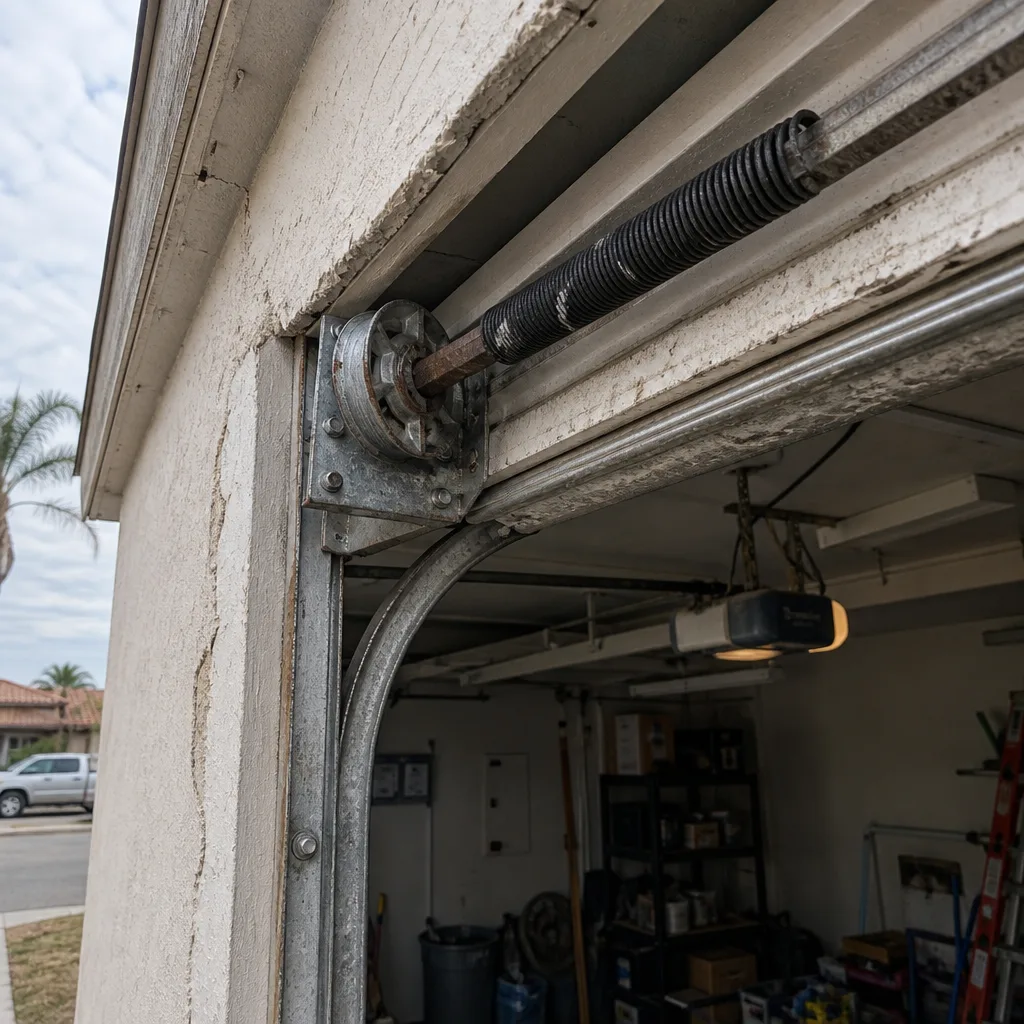 Before
 After
After Before
 After
AfterGarage Door Warning Signs: A Winter Gardens Homeowner’s Reference Guide
A garage door that takes two seconds longer to close than it did six months ago is not “getting old.” It is telling you exactly which component is failing and roughly how many cycles you have left before it stops entirely. In Winter Gardens, where summer heat bakes lubricant out of hinges and winter dampness works into torsion springs, these warnings come earlier and more often than most homeowners expect. Our complete guide to garage doors in Winter Gardens names the actual symptom, the actual cause, and the actual window of time before that cause turns into an emergency. You will learn which sounds mean what, what a failing spring actually looks like, and how to know whether to watch a problem for 30 days or call someone today.
Quick Answer
The most common garage door warning signs in Winter Gardens are grinding, squealing, or rattling noises during operation, a door that slows or “bounces” at the floor, visible rust or gaps on torsion springs, frayed cables, and an opener that strains or hesitates. Any one of these means a specific component is wearing toward failure. A grinding sound usually points to the opener’s gears, a squeal to dry rollers or hinges, and rattling to loose hardware or worn brackets. If you notice any of these signs, the window to act is measured in weeks, not months, and hiring a garage door contractor in Winter Gardens beats waiting every time.
Table of Contents
- The Symptom-to-Cause Index: What Each Sound Actually Means
- What a Failing Spring Looks Like: Visual Signs You Walk Past Every Day
- Why Your Door “Bounces” at the Floor (And Why It Is Not a Sensor Problem)
- The 90-Second Cable Fray Test Every Winter Gardens Homeowner Should Do Twice a Year
- Watch for 30 Days or Call Today: A Plain-Language Decision Framework
- Why Winter Gardens Climate Accelerates Garage Door Wear
- What You Can Safely Check Yourself (And What You Absolutely Should Not)
- Common Mistakes to Avoid
- When to Call a Professional
- Frequently Asked Questions
- The Bottom Line
The Symptom-to-Cause Index: What Each Sound Actually Means
Garage doors speak through three distinct sound categories: grinding, squealing, and rattling. Each one points to a different component, and confusing them leads homeowners to replace the wrong part. Here is the map. A grinding sound, like metal chewing metal, almost always comes from the opener’s drive gear or the chain or belt running against a worn sprocket. The gears inside openers made by Chamberlain and Genie are plastic over a metal core, and once the plastic teeth strip, the metal grinds. That sound does not go away on its own, and running the opener through it ruins the gear completely within a few dozen cycles.
A squeal is different. It is a high-pitched, dry-metal sound that comes from rollers running on their bearings, or hinges that have lost lubrication. In Winter Gardens, the dry summer air pulls oil out of hinges faster than coastal climates do. A squeal is the earliest and cheapest warning sign you will get. Replace or lubricate the rollers now, and the problem disappears for another year or two. Ignore it, and a seized roller will eventually chew a flat spot into the track or snap off a hinge, and that is a bigger repair by several hundred dollars.
Last is a rattle, which people describe as a loose, metallic clatter, often worse on the up-cycle. Rattling means hardware is working itself loose: track bolts, hinge bolts, the bracket holding the opener rail to the ceiling. It can also mean a roller has worn so much slop into its stem that it is dancing inside the track. Tighten loose bolts first, with a half-inch wrench. If the rattle persists, look at the rollers. In our experience in Winter Gardens, rattling is the warning sign homeowners ignore longest, because it sounds harmless and stays harmless right up until a bracket lets go under tension.
Here is the shorthand index we use when someone calls and describes a noise over the phone.
- Grinding: opener gear or chain sprocket failing. Fix now or replace the opener.
- Squealing: dry rollers or hinges. Lubricate or replace rollers. Cheapest fix you will ever do.
- Rattling: loose bolts, worn roller stems, or a failing bracket. Tighten and inspect.
- Popping or snapping: a section is binding in the track, or a spring is catching on debris.
- Thumping or heavy creaking: the door is binding or out of balance, and the spring is compensating incorrectly.
The useful thing about this index is that it narrows the problem before anyone shows up. If you call us and say your door is grinding, we bring opener parts. If you say it is squealing, we bring rollers and lubricant. That specificity saves a second trip, and in Garage Door Repair in Winter Gardens, a second trip is what most people are trying to avoid.
What a Failing Spring Looks Like: Visual Signs You Walk Past Every Day
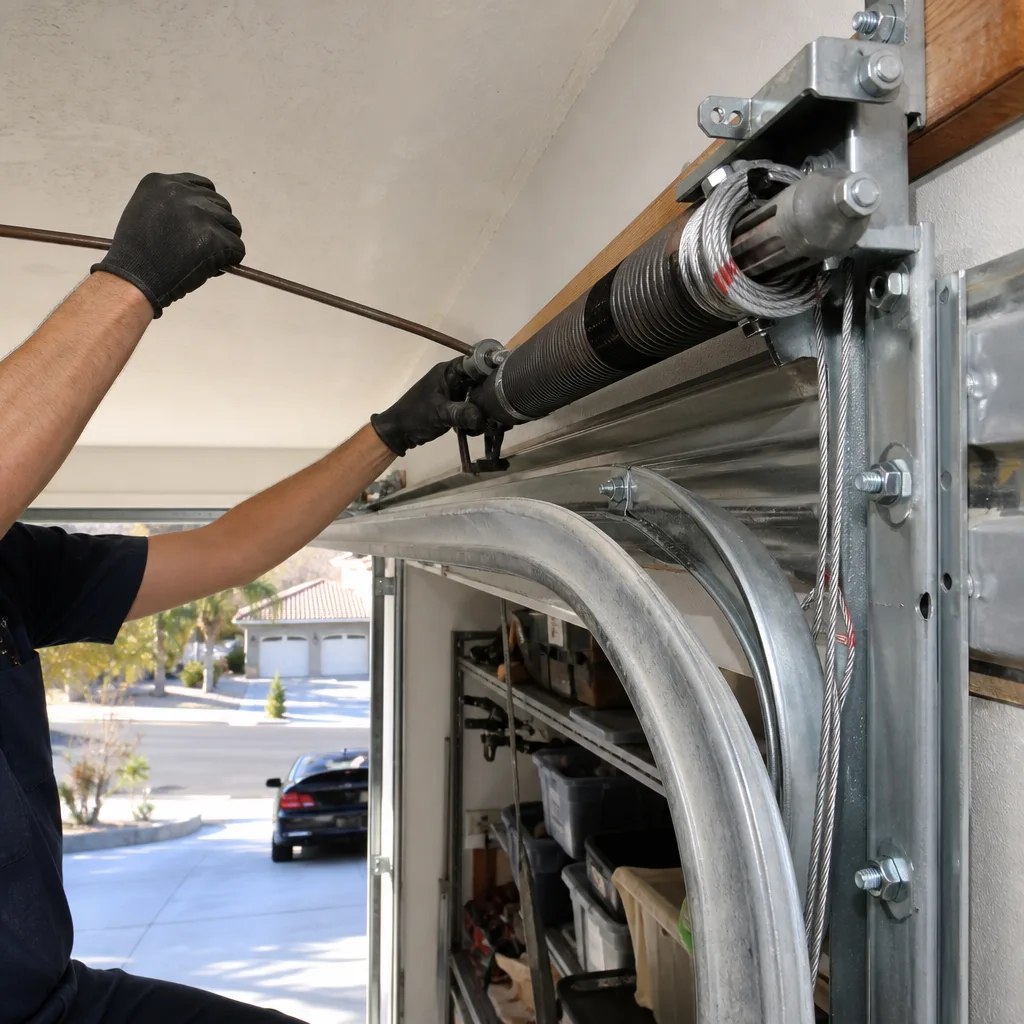
Torsion springs fail visually before they fail audibly. The problem is that most people never look up. Here is what a spring on its last two weeks actually looks like. The first sign is rust, but not the light, dusty surface rust every older spring gets. It is the reddish-brown, flaking rust that looks like the surface is peeling. That corrosion thins the wire and creates stress points. In Winter Gardens, where nights cool and mornings condense moisture in the garage, springs rust faster than homeowners expect, especially in uninsulated garages.
The second sign is a visible gap in the coil. A healthy torsion spring has coils spaced evenly along its length. When you see a gap where the coils have separated from each other, that is the spring stretching under fatigue. Once a gap appears, the spring has already lost meaningful tension and started its final decline. The third sign is a slight lean to the spring itself, a sag or bow that was not there before. That means the spring has lost symmetry, and the door is riding one side harder than the other. You can see these signs with a flashlight and a step stool. You do not need to touch anything. Just look.
We count spring cycles the way you count tire miles. A standard torsion spring is rated for roughly 10,000 cycles. A cycle is one open and one close. If you open your garage door four times a day, that is about 1,460 cycles per year, which means the spring is nearing the end of its life somewhere around year six or seven. Most springs installed by production builders in the Winter Gardens area use the cheapest spring they can source, often a 5,000-cycle spring, which is more like three to four years of real use. If your home is newer and the door is original, that spring is probably already through a third of its life. When we install a spring, we ask about your usage and size the cycle rating accordingly, and we tell you what is left on yours when we service the door for anything else.
One more visual: look at the anchors, the brackets at each end where the spring mounts. A fine dusting of black or red powder under those anchors is pulverized spring coating. That dust is the residue of a spring wearing against its own mount. It is not dirt. It is evidence. And it is one of the signals most Winter Gardens homeowners sweep up without ever asking what it meant.
Why Your Door “Bounces” at the Floor (And Why It Is Not a Sensor Problem)
A door that bounces or hops slightly when it reaches the closed position is a spring tension problem, not a sensor problem. The sensors tell the opener when to stop and reverse. They do not control how the door sits on the floor. What you are seeing is a door that is slightly over-traveling because the spring is not providing the correct counter-balance. The opener lowers the door, the spring fails to hold the expected tension, and momentum carries the door that extra half-inch before the opener stops it, causing the bounce. It is a warning. It is also a tuning signal.
The wrong fix for this is adjusting the opener’s down-force or travel limit settings to compensate. People do that all the time. They think the door is closing too hard, so they dial back the down-force. That stops the bounce, but only by making the opener work harder to press the door down against a spring that is not balancing it correctly. We call this fighting the door. The opener motor was not designed to be the thing that holds your door down. The spring is supposed to do that. When you force the opener to take over, you accelerate wear on the gear, the chain, and the motor itself. If the opener is straining, the problem is almost never the opener. It is almost always the spring.
A correctly balanced door, when released in the middle of the track, should stay in place, not drift up or slam down. We check this on every service call, because balance is the thing that keeps everything else alive. Most doors we see in Winter Gardens that bounce at the floor have a spring that is one adjustment away from being right, or one replacement away from being wrong. The difference in cost between those two outcomes is four times on the low end, so catching the bounce while it is still just an adjustment is the best favor you can do for your own checkbook.
If the bounce ever becomes a slam, even once, stop using the door. That means the spring has lost enough tension that the opener can no longer control the descent. Disconnect the opener and leave the door down until someone can look at it. A door is 200 pounds riding on two springs. Respect it.
The 90-Second Cable Fray Test Every Winter Gardens Homeowner Should Do Twice a Year
Lift cables are the two steel cables running along the outside edges of the door, spooling around drums at the top. They work with the springs to lift the door. When a cable frays, it does not snap all at once. It unravels in stages, and each stage is visible if you know what to look for. Here is the test. Stand inside the garage with the door closed. Look at the cable on the left side. Run your eyes along its full length, from the bottom bracket up to the drum. You are looking for three things, in order of severity.
Stage one: a few individual wires have broken and are sticking out from the cable like whiskers. This is cosmetic damage, but it means the cable has started to fatigue. Stage one is a thirty-day clock. You do not need to panic, but you do need to schedule a replacement.
Stage two: a flattened section, where the cable looks crushed or ribboned, or a spot where the wires are separating and you can see daylight through the strand. This cable is no longer structurally sound. It is a fourteen-day clock at most. It can snap the next time the door cycles.
Stage three: a birdcage, where the cable strands have separated into a bulbous, basket-like shape. This cable has already failed internally. It is holding on by habit. If you see a birdcage, do not use the door. At all. The door can drop suddenly, and a dropping door in a Winter Gardens garage with a car underneath it or a kid nearby is exactly the scenario this test exists to prevent.
Do this test every spring and every fall. It takes 90 seconds. The cables are under constant tension, and they fail without ceremony when they fail. We have replaced cables on doors that were one cycle away from a dropped door, and in every case the homeowner said the same thing: they had never looked at the cables. Now they do. If we replace a cable, we will also ask to look at the drum and the bottom bracket, because when a cable goes, it often takes the drum with it, and fixing one without checking the other is how you end up with a second failure three weeks later. For doors in Winter Gardens that have gone years without a service, cable inspection is part of any complete tune-up, and most homeowners would rather know today than find out at nine o’clock on a Sunday night.
Watch for 30 Days or Call Today: A Plain-Language Decision Framework
Every warning sign on this page fits into one of two buckets. The first bucket is watch for 30 days. The second is call today. Here is how to tell the difference, without needing any expertise. Ask yourself three questions.
- Is the problem getting worse by the week, or has it been stable? Stable noises, like a consistent squeal, can be watched briefly. Worsening noises, like a grinding that gets louder each cycle, cannot.
- Does the problem involve a part under tension? Springs and cables are under torsion and high tension. Any visible failure on those parts means call today, because the consequence of failure is sudden and dangerous. Rollers, hinges, and track bolts are not under the same life-threatening tension.
- Is the door’s safe operation compromised? If the door reverses unexpectedly, slams, hangs crooked, or will not stay in place when released, the door is not safe to use. That is a call today, every time.
Here is the plain-language version. Squealing rollers? Watch it for 30 days, but lubricate and see if it quiets. Rattling when the door moves? Tighten the obvious bolts, then recheck. A spring with a visible gap or a cable with a birdcage? Call today. A door that bounces at the floor and then starts slamming a week later? Call today. A grinding that has been grinding for six months? The gear is already gone. Call today, because it is about to stop moving entirely, and a door that will not open with a car trapped inside is a different kind of urgent.
The reason we push homeowners in Winter Gardens toward faster action on spring and cable issues is simple math. A spring replacement is a few hundred dollars. A spring that snaps while the door is open can drop a 200-pound door, and the damage to the door sections, the track, the opener, and whatever is underneath it turns a few hundred dollars into a few thousand. We would rather replace a spring a week early than a door a week late, and every savvy homeowner we know feels the same way after they see the difference on paper.
Why Winter Gardens Climate Accelerates Garage Door Wear
Winter Gardens sits inland enough to catch real summer heat, and close enough to the coast to get cool, damp nights for much of the year. That combination, hot days and condensing nights, is tough on metal garage door parts, which is why seasonal garage door care for Winter Gardens matters so much. Lubricant does not just dry out in this climate; it evaporates in the daytime and then gets washed thin by condensation at night. Hinges and rollers run dry faster than in almost any coastal ZIP code. Rust forms quicker, especially on springs and cable hardware. And the temperature swings cause metal to expand and contract daily, which slowly works bolts loose and accelerates fatigue at stress points like the coil ends of torsion springs.
Wood doors in Winter Gardens also move with the seasons. The dry heat of August shrinks panels and can leave gaps where the door meets the floor, letting dust and pests in. The damper months swell the same wood, making the door heavier and changing its balance. A door that was perfectly balanced in July may be slightly out of balance by December, simply because the wood has absorbed ambient moisture. That is not a defect. It is physics. But it means balance checks matter more in Winter Gardens than they would in a climate with narrower humidity swings.
What this means practically is that the standard maintenance advice of “inspect your garage door once a year” is too slow for this climate. We tell homeowners here to check their cables twice a year and to listen to their door every single time they use it. The sound of your garage door is a diagnostic. You hear it in the background of your day, and after a while you stop noticing it. Start noticing it again. When the sound changes, something has changed. That is the whole system, and it works as well in Winter Gardens as it does anywhere else, because the door always tells you.
What You Can Safely Check Yourself (And What You Absolutely Should Not)
Here is what a homeowner can do without risk. You can look at the springs with a flashlight and note rust, gaps, or a lean. You can inspect the cables visually exactly as described above. You can tighten track bolts and hinge bolts with a wrench, provided the door stays down and the opener is unplugged while you do it. You can lubricate hinges and rollers with a garage-door-rated lubricant, the white lithium or silicone kind, not WD-40. And you can listen to your door every time it operates and write down what changes. That is enough to catch the majority of failures early. You do not need special tools or advanced knowledge. You need to look at the door the way you look at your car’s tires, with the understanding that what you see is information.
Here is what you should not do. You should not touch, adjust, remove, or release a torsion spring. Ever. Those springs hold enough stored energy to break bones or worse if they let go while you are working on them. The winding bars, the set screws, the anchoring brackets, all of it is a job for a professional with the right training and the right tools. You should not attempt to replace a lift cable, because removing the old cable requires releasing spring tension, which brings you right back to the same hazard. You should not try to straighten a bent track with a hammer; tracks are under constant load, and a botched straightening job causes the rollers to bind and the door to jam. And you should not try to adjust a door’s balance by moving spring set screws yourself, because the spring is the most dangerous part of the whole assembly.
The rule we use is simple: if a part is under tension and you are not trained to work on it, do not touch it. If you can see the problem, describe it and call. We will ask you questions, quote the job, and fix it properly. A door is 200 pounds riding on two springs. Respect it. That is the most important sentence on this page, and it is the one I repeat to every homeowner in Winter Gardens who calls and asks whether they should try something themselves.
For everything else, from new door installation to opener replacement, Garage Door Installation in Winter Gardens is a job we do with a written quote and a fixed price before we start, because your garage is not the place for surprises.
Common Mistakes to Avoid
- Lubricating a grinding opener. A grinding sound from the opener is a stripped gear, not a dry one. Adding lubricant to stripped gears does nothing except coat the shavings. The only fix is a gear replacement or a new opener.
- Adjusting the opener force to fix a bouncing door. This masks a spring problem by making the opener fight the door instead of letting the spring balance it. The opener loses that fight every time, and the repair bill grows.
- Ignoring a squeal until it stops on its own. A squeal that stops is often a roller that has seized, and now the roller is flat-spotting in the track instead of rolling. The noise stops, but the damage accelerates.
- Spraying WD-40 on hinges and rollers. WD-40 is a penetrant, not a lubricant. It cleans out what little lubrication remains and leaves the metal drier than before. Use a silicone or white lithium garage door lubricant.
- Replacing only one spring on a two-spring door. Both springs have the same cycle count. If one fails, the other is not far behind. Replacing one saves short-term money and costs a second service call within months, in most cases.
- Assuming a newer door does not need inspections. Builders in the Winter Gardens area often use entry-level springs rated for 5,000 cycles. A newer door can be closer to a spring failure than an older door with premium hardware. Age is not the only metric; cycle count is.
- Continuing to use a door after a single slam. If the door has slammed even once, the spring has lost tension and the door is no longer safe to operate under opener power. Each subsequent cycle is a risk.
When to Call a Professional
Call the day you see a spring gap, a cable birdcage, or a door that slams, jerks, or hangs crooked. Call when the grinding gets worse by the day, when the door reverses for no reason, or when the opener strains so hard the motor sounds like it is pulling a truck up a hill. Those are not maintenance issues. They are failures in progress. Otto’s Garage Door offers free estimates in Winter Gardens, and the person who answers the phone is the person who will quote your job, because there is no call center and no middleman. Call (619) 935-3793. We have been in this county since 2004, fixing doors the way they should have been fixed the first time, and every job carries the 90-Day Done Right Promise in writing.
If you are not sure whether your door’s warning sign is a watch-30-days or a call-today, call anyway. It costs nothing to ask, and the answer will be straight. You can also get help with your garage door opener in Winter Gardens, or use the Otto’s Garage Door home page to see everything we do. We have been the name people in Winter Gardens call since 2004, and Otto is a palindrome: reads the same from either end, same as the door.
Frequently Asked Questions
Spring replacement typically runs between $180 and $340 depending on the spring’s size and cycle rating, and that includes both springs when both are near the end of their life. The price is quoted and agreed before any work starts, and it does not change between the phone and the driveway. Call (619) 935-3793 for an exact quote, because the spring size matters and guessing will not help you.
Most spring, cable, and roller repairs in Winter Gardens are done the same day you call, because we keep the common parts on the truck and the person who answers the phone is the person who shows up. If a special-order part is needed, we will tell you on that first call and give you an honest timeline. Call (619) 935-3793 and ask; the worst case is you know exactly where you stand.
No. The number we quote on the phone is the number you see on the invoice, and we hold that number when we arrive. If we find something else wrong while we are there, we will stop, show you what we found, and get your approval before touching it. But the original quote stands unless you authorize an additional repair. We put the 90-Day Done Right Promise on every invoice in writing for exactly this reason.
Look for rust that flakes, a visible gap in the coil, or a slight lean in the spring itself, all visible with a flashlight and no tools. Each of those is a sign of a spring in its final weeks. You can also listen for a loud pop or bang when the door moves, which is the spring starting to catch. If you see a gap or rust flaking, call (619) 935-3793 for a free estimate and do not run the door until it has been looked at.
We carry the most common springs, cables, rollers, hinges, and opener gears on the truck, which is why most same-day calls finish in one visit. The brands we work with most in Winter Gardens include Chamberlain, Genie, Clopay, and Amarr, and we match the part to your door, not the other way around. If a part needs to be ordered, you will know before we leave the first visit.
At least twice a year in this climate, because the hot days and damp nights accelerate lubricant loss and rust formation faster than in coastal or desert communities. The cable check described in this guide takes 90 seconds and should be done every spring and fall. A full balance and hardware check is part of any tune-up we do, and most Winter Gardens doors we see every year are better off for it. Call (619) 935-3793 to schedule one.
The Bottom Line
Your garage door speaks in specific signs, and each one points to a specific fix. Grinding means gears. Squealing means rollers. Rattling means loose hardware. A bouncing door means springs. Rust, gaps, and leans on springs mean days to weeks, not months. Frayed cables have three visible stages, and the last one is a dropped door waiting for the wrong moment. Watch the stable noises, call on the worsening ones, and never touch anything under tension. In Winter Gardens, checking twice a year is the right rhythm, and calling a professional on the first sign is the cheapest money you will ever spend on a garage door. For more guides & resources, visit our blog.
Written by Otto Reinhardt, Owner at Otto’s Garage Door, serving Winter Gardens since 2004.