
Last updated September 10, 2026
Full 25-point door and opener safety check with every visit - springs, cables, rollers, tracks, and your LiftMaster or Chamberlain opener included
You get a price before we start. It does not change when the truck arrives.

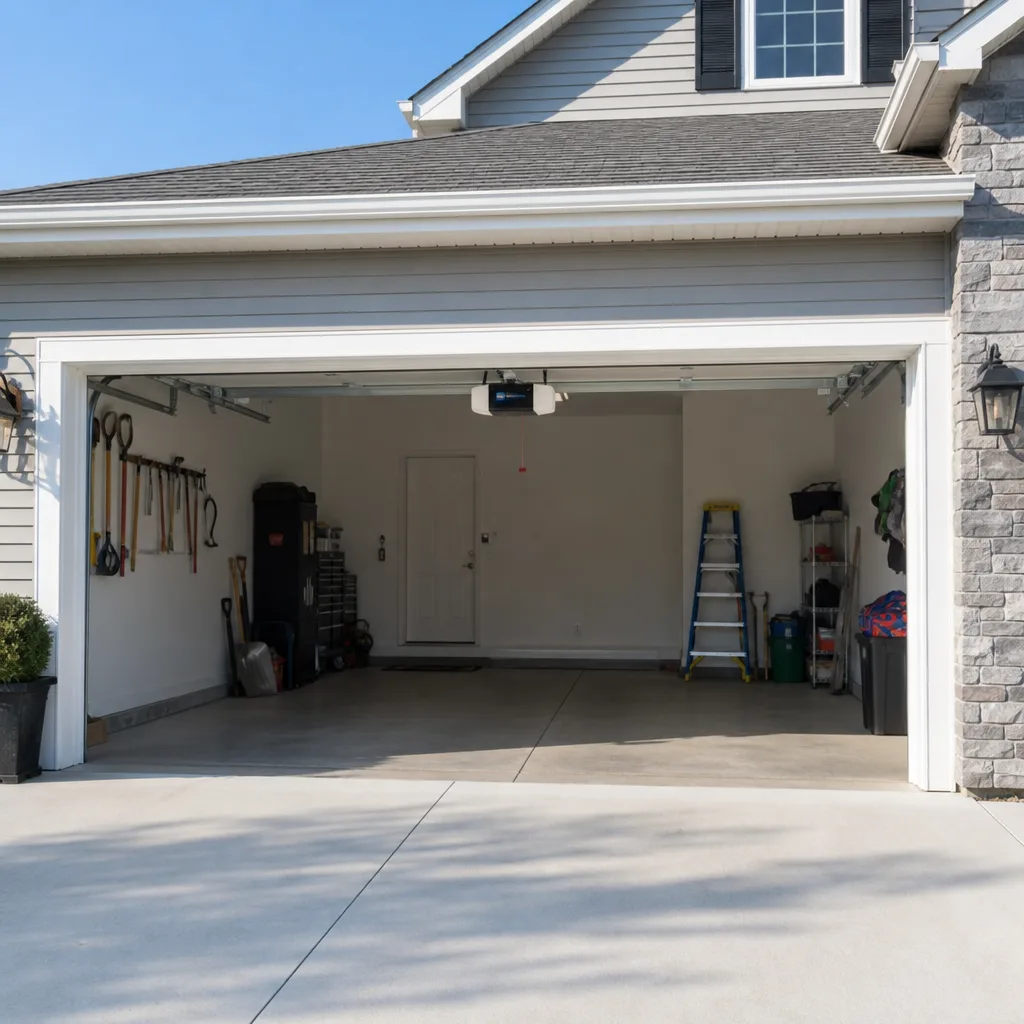
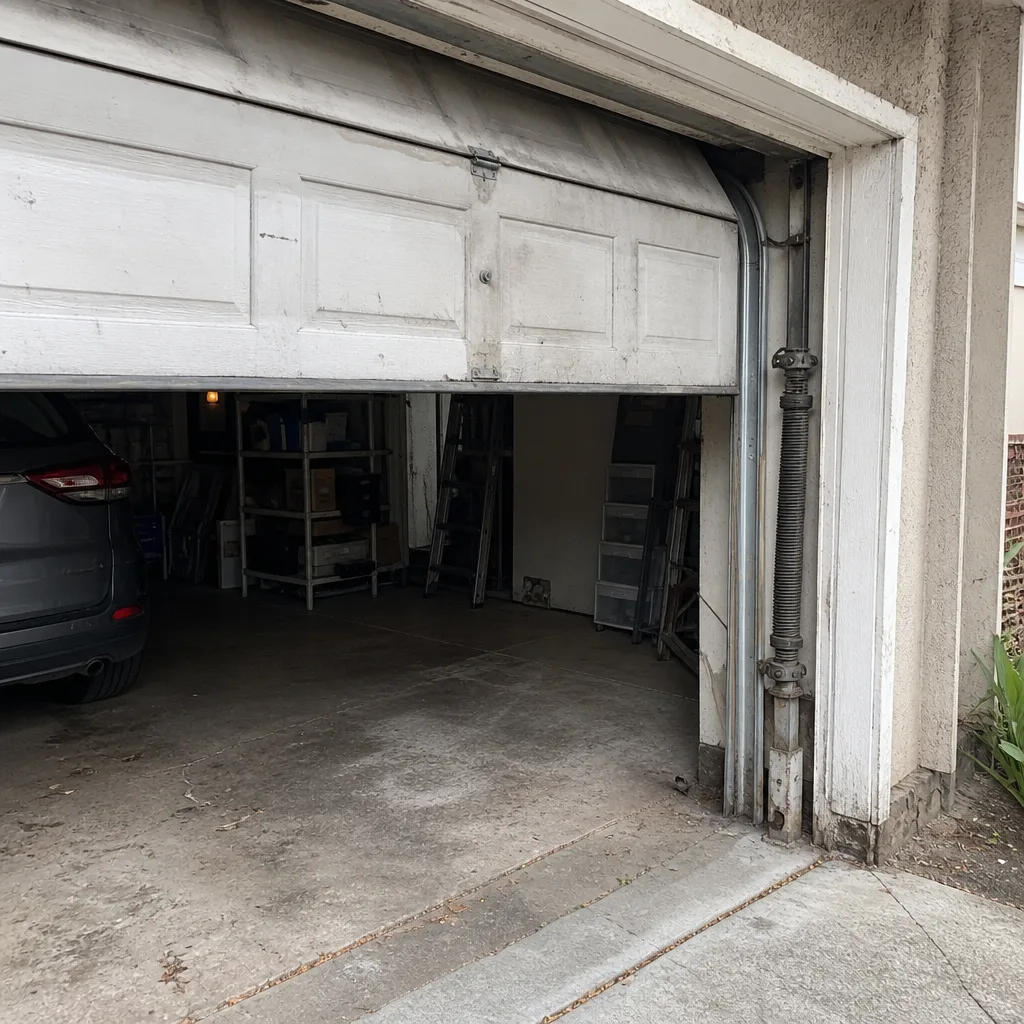 Before
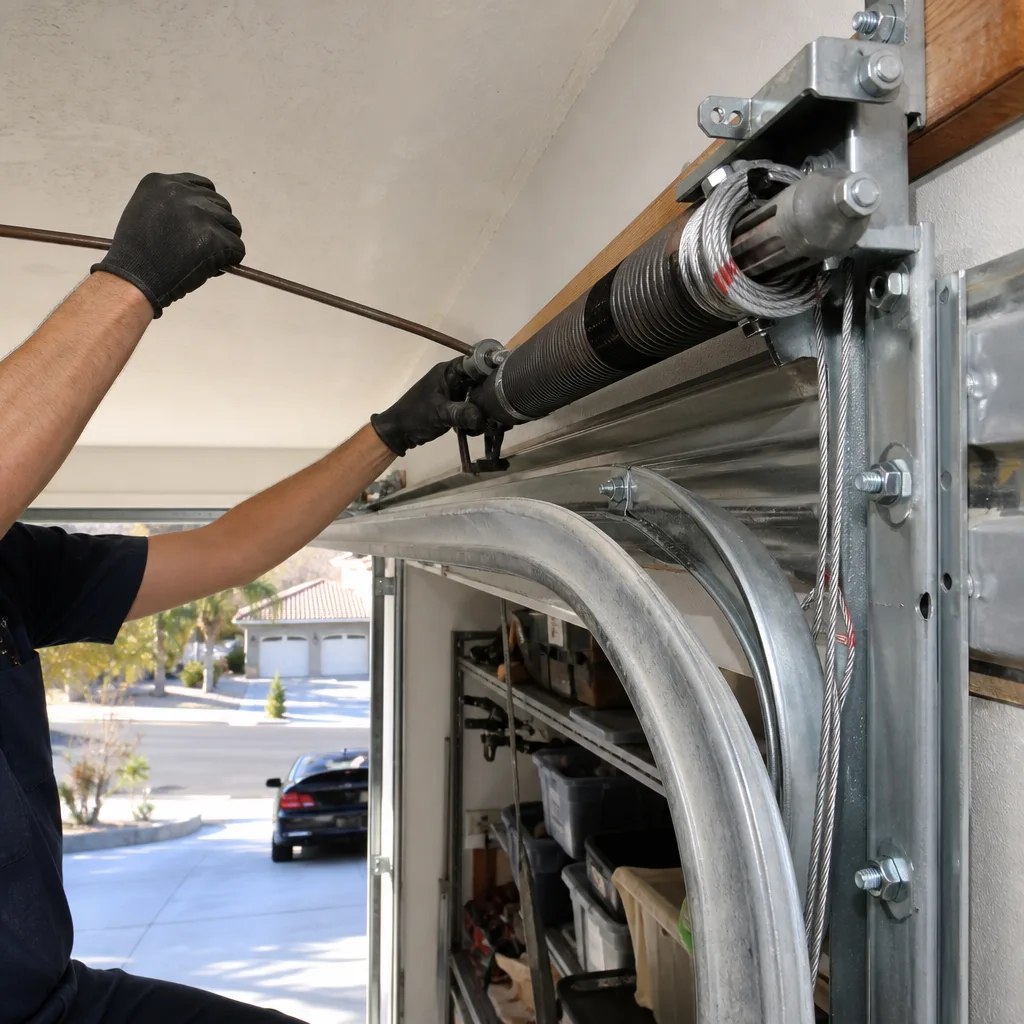 After
After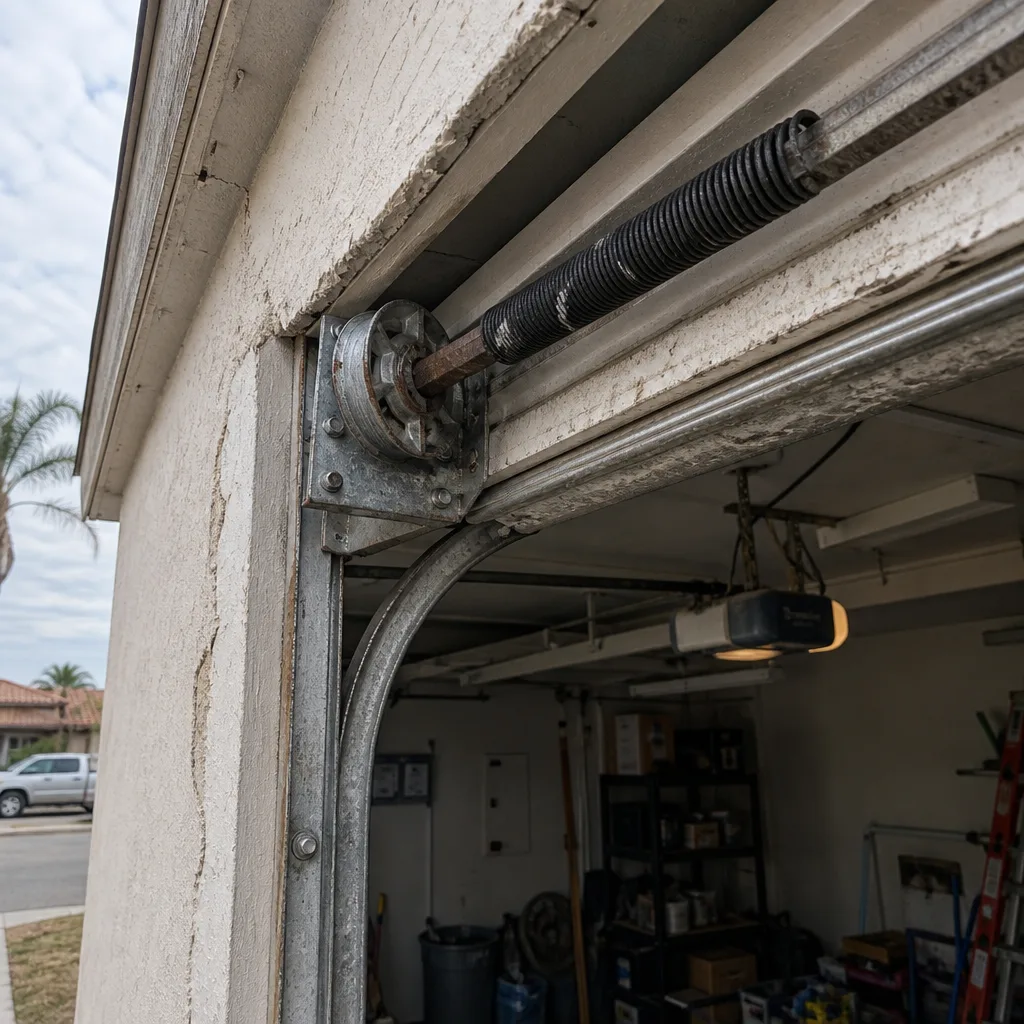 Before
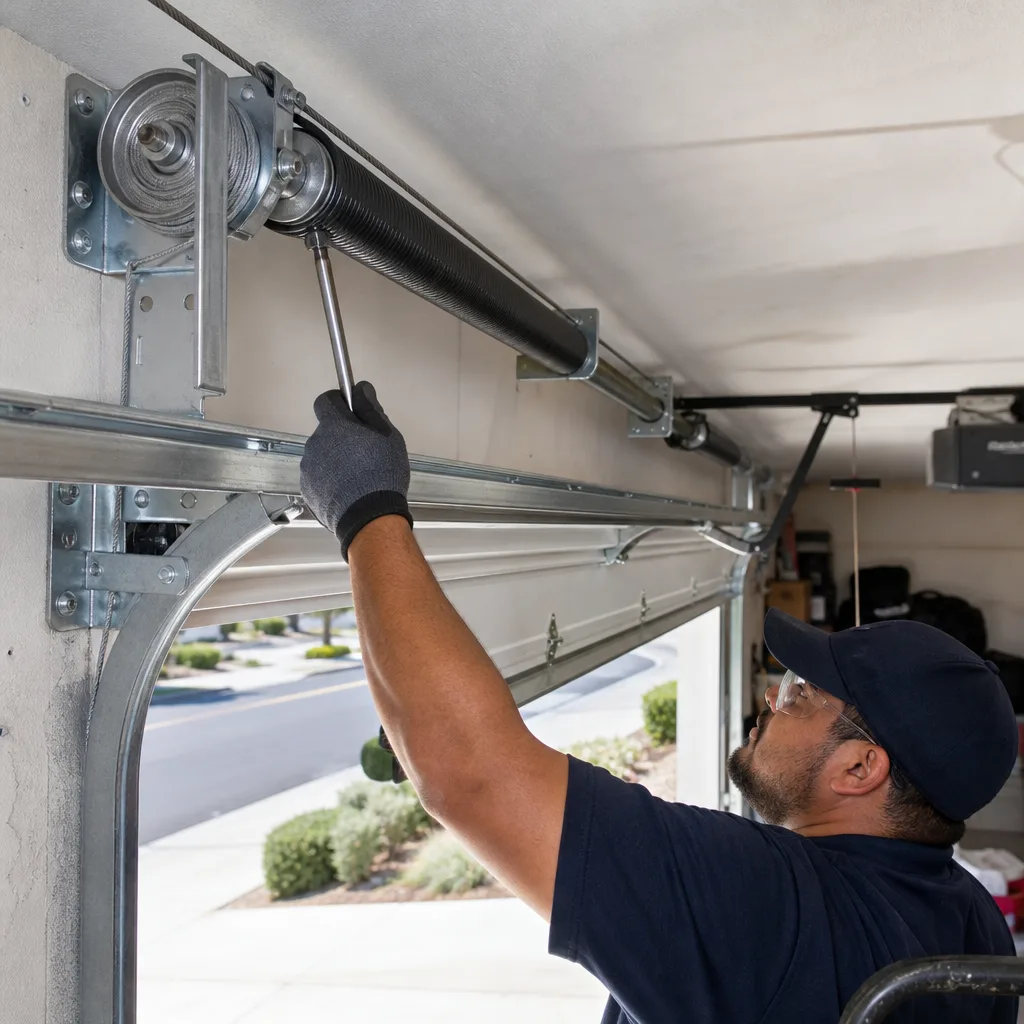 After
After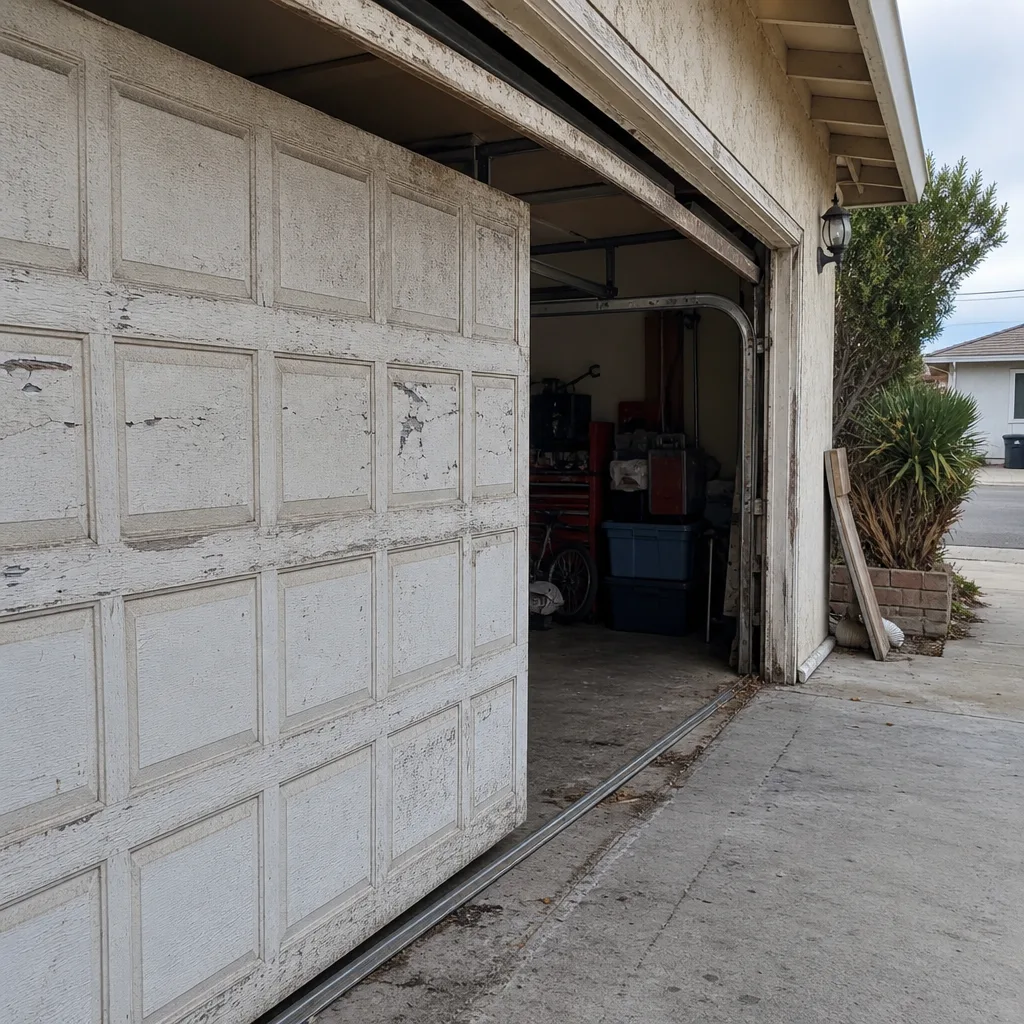 Before
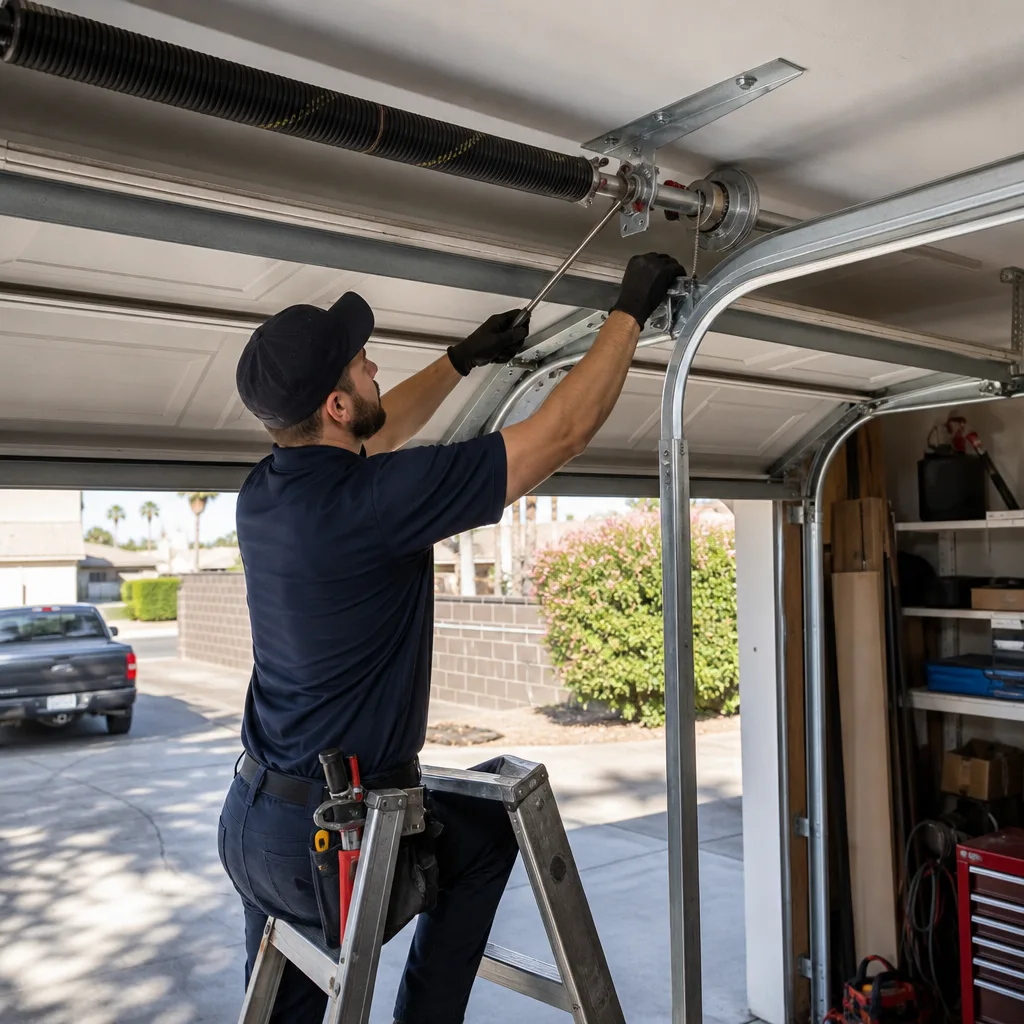 After
AfterHow to Hire a Garage Door Contractor in Winter Gardens: A Step-by-Step Guide
Here’s the thing most Winter Gardens homeowners don’t realize until it’s too late: the garage door is the single heaviest moving object in your house, and California has a completely different set of rules for who’s allowed to work on it. A handyman who fixes your fence has no business touching a 200-pound door riding on torsion springs. The contractor who answers the phone in Winter Gardens might be sitting in a dispatch center in Phoenix, and the tech who shows up at your door could be a subcontracted day-laborer with no insurance tied to your address. By the time you finish this guide and our complete guide to garage door in Winter Gardens, you’ll know the four questions that expose a middleman in under a minute flat, how to verify a license before you ever hand over a deposit, and the two line items shady operators always leave off the estimate until the job is done.
Quick Answer
To hire a garage door contractor in Winter Gardens, verify their California CSLB license at cslb.ca.gov, ask whether they carry garage-door-specific liability insurance, insist on a written estimate with parts and labor separated, and ask who physically does the work. A legitimate local operator like Otto’s Garage Door answers with a name, a license number, and a published Winter Gardens address you can drive past before you sign anything.
Table of Contents
- What California’s CSLB License Actually Covers for Garage Door Work
- How to Verify a Garage Door Contractor’s License in Under Two Minutes
- Garage Door Insurance: Why It Matters If a Spring Snaps Mid-Install
- Owner-Operator Versus Franchise Middleman: Four Questions That Expose the Difference
- Why the Lowest Quote Almost Always Costs More in Winter Gardens
- What a California Written Estimate Must Include
- A Step-by-Step Checklist for Hiring a Winter Gardens Garage Door Contractor
- Common Mistakes to Avoid
- When to Call a Professional
- Frequently Asked Questions
What California’s CSLB License Actually Covers for Garage Door Work
California’s Contractors State License Board (CSLB) classifies garage door work under the C-61 / D-28 category, which is specifically for door and gate contractors. This is not a general contractor license, and it’s not a handyman permit. A D-28 classification means the holder has demonstrated at least four years of journey-level experience in the trade and passed a written exam covering door installation, spring mechanics, opener wiring, and relevant California building code. In Winter Gardens, where homes range from 1960s ranchers to newer construction, that code knowledge matters more than people think. Older garages often have door frames that have shifted over decades, and the opening that once fit a standard door perfectly may now require a custom fit.
What the license does not cover: any electrical work beyond low-voltage opener wiring. If the opener needs a new circuit or upgraded wiring, that falls outside the D-28 scope. A legitimate garage door contractor knows this line and will tell you when an electrician needs to be called. That’s a sign of honesty, not weakness. Otto’s Garage Door has held its D-28 license since 2004, with the number published right on the website and every invoice. If a contractor hesitates to give you their license number in the first phone call, hang up and call the next name on your list.
- D-28 is the specific classification: Door and gate contractors only.
- Four years of experience required: Not a two-week training course.
- Electrical work stops at low-voltage: Anything going into your panel needs a licensed electrician.
- License numbers are public record: Any contractor who won’t share theirs is hiding something.
We tell every Winter Gardens homeowner we talk to the same thing: the license is the bare minimum. For seasonal garage door care for Winter Gardens, that license matters year-round. It proves someone passed a test and isn’t actively wanted by the state. It does not prove they’ll show up on time, use American-made springs, or answer their phone at nine o’clock at night when your door is stuck half-open on the slope of a Winter Gardens driveway. Those things come from running an owner-operated shop, which is a different standard entirely.
How to Verify a Garage Door Contractor’s License in Under Two Minutes
The CSLB’s website is not glamorous, but it works. Go to cslb.ca.gov, click “License Check,” and type in the company name or license number. Within ten seconds you’ll see the license status, the business name, the classification, any workers’ compensation insurance on file, and whether there are any active complaints or legal actions against the licensee. This process takes less than two minutes and costs you nothing. It’s the single most valuable free tool a Winter Gardens homeowner has when vetting a garage door contractor.
What should you look for? First, the license status should read Active, not “Suspended” or “Inactive and Unable to Work.” Second, the classification should include D-28 specifically, not just “General Building.” A general contractor license does not prove the holder knows anything about torsion springs or opener logic boards. Third, check the insurance section. In California, contractors who employ anyone, even part-time, must carry workers’ compensation insurance. A contractor without it who sends an employee to your Winter Gardens home and that employee gets hurt on your property could result in a claim against your homeowner’s insurance. Fourth, look at the number of years licensed. The CSLB records the original issuance date. A license issued two years ago is not necessarily bad, but a license issued two decades ago tells you something real about who has been doing this long enough to have survived a recession, a pandemic, and several Springs of unspeakable quality shipped from overseas.
- Go to cslb.ca.gov and click License Check.
- Type the business name or license number.
- Confirm the status reads Active.
- Confirm the classification includes D-28.
- Verify workers’ compensation insurance is on file if the contractor has employees.
- Note the original license date for a sense of how long they’ve been in business.
When you call Otto’s Garage Door home, the person who answers will give you the license number before you even ask, because we’ve had it memorized since 2004. That’s what an owner-operated shop sounds like.
Garage Door Insurance: Why It Matters If a Spring Snaps Mid-Install
This is where a lot of Winter Gardens homeowners learn an expensive lesson. General contractor liability insurance, which is what many handymen and “we do everything” outfits carry, typically covers property damage from common carpentry or plumbing work. But garage doors introduce a specific risk: coils of high-tension steel restrained under 150 to 300 pounds of torque per spring. When a spring is being wound, adjusted, or released improperly, it can fail catastrophically. A torsion spring that snaps during installation is a steel projectile moving at roughly 190 miles per hour. If it goes through your car windshield, through your drywall, or into a person, the liability question goes from theoretical to very real in about half a second.
Garage-door-specific liability insurance underwrites exactly this risk. The premiums are higher because the exposure is higher, which is precisely why cut-rate operators avoid carrying it. They roll the dice on every job and the homeowner rolls it with them. When you’re vetting a contractor in Winter Gardens, ask this exact question: “Do you carry garage-door-specific liability insurance, and can you send me a certificate with my name and address listed as additionally insured?” A legitimate operator says yes and has the policy number ready. A middleman or handyman will mumble, change the subject, or offer to “check on that” and never follow up.
This matters even more in Winter Gardens than in some neighboring communities because of the age of our housing stock. Older attached garages often sit beneath bedrooms, and the wall separating garage from living space is frequently original drywall with no fire-rating upgrade. A spring failure that punctures that wall isn’t just a repair, it’s a family safety issue. We’ve seen the aftermath of garage doors that were installed by uninsured operators in this neighborhood, and the result is never a savings.
- General liability is not enough: It doesn’t underwrite spring-vector risk.
- Ask for a certificate with your address: Not a PDF from the contractor’s website.
- The spring is the danger: Not the door itself. Torsion springs hold enough tension to kill.
- Workers’ comp protects you too: An injured uninsured worker can file against your homeowner’s policy.
We carry garage-door-specific liability across every job we do in Winter Gardens. The certificate costs us real money every year, and it’s worth every dollar because it means we never have to explain to a customer why our insurance doesn’t cover the thing that just happened in their garage.
Owner-Operator Versus Franchise Middleman: Four Questions That Expose the Difference
The most expensive garage door repair in Winter Gardens is often sold by a brand you’ve seen advertised during football games. A national franchise buys the ad time, then routes calls through a centralized system, then sells the job to whichever independent contractor in the area will take it for the lowest cut. The technician who arrives wears a uniform with the franchise logo, but he’s not an employee of the franchise. He’s a third-party contractor with his own insurance, his own standards, and his own incentive to upsell you on parts and labor that may not be needed. When something goes wrong, the franchise blames the contractor and the contractor blames the franchise, and you’re the one standing in a Winter Gardens driveway with a door that won’t close and no one willing to own the problem.
These four questions will tell you, within the first two minutes of a phone call, which kind of operation you’re talking to.
- “Who actually does the work when I schedule a repair?” A local owner-operator answers with a name: “I do, or Billy does, and we’re both employees of the company.” A middleman starts talking about “our network of vetted partners” or “our service area providers.” That’s the tell.
- “What’s the name of the person I’ll see at my door?” This isn’t about friendship; it’s about accountability. A local shop gives you a name and often a description: the person with the goatee, his truck’s been in this neighborhood for fifteen years. A franchise gives you a four-hour window and a confirmation number.
- “Can I visit your shop or your published address?” In Winter Gardens, a local operator has a physical address, often on a street with a roll-up door and a parts bench visible from the sidewalk. A franchise has a PO box in Nevada and a registered agent in Delaware. Otto’s address is published on the Garage Door Repair in Winter Gardens page, and anyone is welcome to drive by.
- “If something goes wrong on a job, who do I call?” Listen for the mechanics of the answer. A local owner says, “You call my cell phone, which I answer.” A middleman says, “You’ll have a dedicated case number and our resolution team will reach out within 24 to 48 business hours.” That’s not an answer; that’s a queue.
We’ve been in this county since 2004, and one of the quiet benefits of that tenure is seeing the same faces at the hardware store, the gas station, and the feed store on Saturday morning. Otto’s reputation in Winter Gardens isn’t backed by a franchise manual, it’s backed by the fact that he has to see you around town for the next twenty years. That’s the L.O.C.A.L. deal in practice: Local roots, On time, Community first, Accountable, Loyal.
Why the Lowest Quote Almost Always Costs More in Winter Gardens
Every garage door quote is a math problem that most homeowners never see solved on paper. The door itself is a known cost, the same way a tire is a known cost. The variables are the quality of the springs, the grade of the hardware brackets, the number of springs used, and the warranty behind the labor. A cut-rate quote in Winter Gardens typically gets you a door with low-cycle springs rated for 7,000 to 10,000 open-and-close cycles. That sounds like a lot until you do the math: four cycles a day, 365 days a year, means those springs are done in just over four years. A quality installer puts in springs rated for 20,000 to 30,000 cycles, which on the same usage schedule lasts more than a decade.
Here’s where the hidden markup lives. The cut-rate operator doesn’t actually lose money by quoting low. He makes it back in three places.
- Spring count: Cheap installs use a single spring instead of a pair. One spring does the same lifting work as two, but it cycles faster and fails sooner. The savings to the installer is thirty to fifty dollars. The cost to you is a failure in half the time and another service call.
- Bracket grade: Standard-grade steel brackets cost a few dollars each and can rust through in a coastal-adjacent climate like Winter Gardens, where the marine layer off the Pacific pushes damp air inland. Galvanized or powder-coated brackets cost more and last decades. The cheap quote uses the cheap brackets.
- Parts brand: An Amarr or Clopay door comes with manufacturer-matched hardware and a real warranty. A no-name import door, even if it’s visually identical, ships with generic rollers and hinges that wear against the track within two years. We’ve replaced dozens of these in Winter Gardens, many of them on doors that were “a great deal” eighteen months earlier.
We quote the job on the phone and hold that number at the door. No discovery fees, no “while I was in there I noticed” add-ons, no percentage bump for paying by card. The price Otto gives you is the price on the invoice. That’s not a sales tactic; it’s the result of doing Garage Door Installation in Winter Gardens long enough to know the labor, the parts, and the door before the truck leaves the shop. If you’ve got a written estimate from another company, we’ll give it a free second opinion, no trip charge inside the county. We’d rather teach you what to look for and earn the next job than win this one on a technicality.
What a California Written Estimate Must Include
California has some of the strongest consumer protection laws for home improvement in the country, and garage door work falls squarely under the Home Improvement Contract requirements. A real written estimate in this state is not a text message with a number, and it’s not a verbal promise made over the phone. It’s a document that includes specific line items, and if it’s missing certain pieces, the contractor is already out of compliance.
Here’s what your estimate from a Winter Gardens garage door contractor should contain, and the two things that frequently get left off by operators who plan to inflate the bill later.
- The contractor’s name, business address, and CSLB license number. Not a PO box, not a DBA with no license behind it. This information should match exactly what you found on the CSLB website.
- A description of the work, including the door manufacturer, model (or equivalent), size, and finish. “New garage door, white” is not a description. “Clopay 8×7 flush steel, white, R-18 insulated” is a description.
- Labor and materials separated. This is one of the two line items routinely omitted. Without it, you can’t compare labor rates across bids, and you can’t see whether the contractor is hiding a low parts price behind a padded labor rate or vice versa.
- A total price, including tax and any disposal or haul-away fees for the old door. The haul-away fee is the second omission that bites homeowners in Winter Gardens. The old door and its tracks weigh a lot, and disposing of them costs money. If “removal of old door” doesn’t appear on your estimate, you’re going to see a line for it on the final invoice, or you’re going to find out the old door is being left in your side yard.
- A payment schedule with a down payment not exceeding $1,000 or 10 percent, whichever is less. This is California law, not a courtesy. Any contractor asking for more than that upfront is in violation of the Contractors State License Law.
- The start and completion dates. Even estimates need these. A contractor who won’t commit to dates won’t commit to the job.
Otto writes every estimate himself, in plain English, with the parts and labor split down the middle of the page. The 90-Day Done Right Promise goes on every invoice in writing: if it’s not done right, it gets made right, and one call brings the owner back. We’ve never had to hide behind a payment schedule or a disposal fee because we quote the whole job the first time.
A Step-by-Step Checklist for Hiring a Winter Gardens Garage Door Contractor
Here is the entire process, from first phone call to final walkthrough, in the order it should happen. Print this if it helps. Tape it to the fridge. Use it the next time a spring lets go or a door starts groaning in the middle of a Winter Gardens night.
Step 1: Gather names from people who actually live here
Start with neighbors, not search engines. Ask on Nextdoor, ask at the hardware store, ask the person whose garage door you’ve seen open and close for years on your street. In Winter Gardens, the best contractor referrals come from people who’ve had a door fail at 9 PM on a Wednesday and watched someone show up anyway.
Step 2: Check every name against the CSLB
Before you call anyone, run the license check from the section above. If the name doesn’t appear, the person doesn’t exist as a contractor regardless of what their van says.
Step 3: Call and ask the four questions
Who physically does the work, what’s the name of the person I’ll see, can I visit your shop, and who do I call if something goes wrong. Write down the answers. Read them back the next morning. If they still make sense, proceed.
Step 4: Get the estimate in writing
Insist on every item from the written-estimate list above. If the contractor balks at putting things down on paper, that’s a decision maker. Walk away.
Step 5: Compare bids by line item, not by bottom line
Set two estimates side by side and compare spring quality, bracket grade, door model, and labor rates specifically. A three-hundred-dollar difference in total price usually means a three-hundred-dollar difference in what’s actually going into your garage.
Step 6: Confirm insurance before the job starts
Ask for the certificate of insurance with your address listed as additionally insured. If they can’t produce one within a business day, they don’t have one, and the risk is yours.
Step 7: Do the walkthrough together when the job is done
Every good garage door contractor does the final walkthrough with you. Test the balance, cycle the door, listen to the opener, operate the safety reverse. If they’re rushing out before you’ve seen the work, that’s a red flag the size of a roll-up door.
This process takes a little more time than picking the first ad in the phone book, but the phone book doesn’t show you who’s going to answer when your opener dies on a twenty-degree January morning in Winter Gardens. Otto’s been answering that phone since 2004, often from his truck, often with a part already in the back. That’s the difference between hiring a contractor and hiring a neighbor.
Common Mistakes to Avoid
- Accepting a verbal quote: In California, a verbal quote is worth the air it travels through. The Home Improvement Contract law exists because too many Winter Gardens homeowners got burned by “I said $400, not $700.” Get it in writing or don’t get the work done.
- Hiring based on the lowest number alone: The low bid is frequently subsidized by cheap springs, single-spring setups, and generic hardware. The total cost over five years will exceed the “expensive” quote.
- Skipping the CSLB check: The website takes two minutes and the information is free. Not checking a license is like buying a used car without looking at the title.
- Assuming a franchise logo means a franchise employee: Most national garage door brands operate on a subcontractor model. The name on the shirt may not be the name on the license or the insurance that covers your address.
- Letting anyone work on torsion springs who isn’t D-28 licensed: A handyman with a crescent wrench can make a bad situation lethal. Torsion springs are not a DIY-adjacent part; they’re a weapon under load. Never let an unlicensed person touch them.
- Ignoring the haul-away line item: Your old door and hardware have to go somewhere, and disposal costs money. If it’s not in the estimate, it’ll be in the final bill or in your side yard.
- Not asking about the 90-day or follow-up standard: A good contractor in Winter Gardens stands behind the work and writes that standard down. A bad contractor starts edging toward the truck the moment the check clears.
When to Call a Professional
If you can hear the springs binding, see the door catching on its tracks, or smell burning from the opener motor, stop using the door and call someone. A door that’s off-balance puts strain on every component, and a strained opener burns its own motor out prematurely. If the door won’t close completely at night, you’re leaving the largest entry point to your house open, and that’s a security risk with an address on it. If you’ve got a door from a previous decade in a Winter Gardens home and the springs are original, they’re living on borrowed cycles. We count spring cycles the way you count tire miles, and we’ll tell you honestly what’s left on yours. Otto’s Garage Door offers free estimates in Winter Gardens - call (619) 935-3793 and a live person answers, day or night.
Frequently Asked Questions
Run their business name through the CSLB license check at cslb.ca.gov and confirm the status is Active and the classification includes D-28 for doors and gates. The license number should match what the contractor gives you over the phone, and the business address should be a real place, not a PO box.
A contractor holds a D-28 license from the California CSLB, carries specific liability insurance, and can legally enter into a home improvement contract. An installer may just be an employee or subcontractor working under someone else’s license, or may hold no license at all. In Winter Gardens, you want the contractor’s name on the contract, not just the person who shows up with the tools.
The range in Winter Gardens depends entirely on what’s broken. A simple roller or hinge replacement might run $85 to $180, a spring replacement typically lands between $180 and $340 per spring, and a full door replacement with installation runs from $1,100 to $2,800 depending on the door model, insulation level, and old-door removal. Any quote far below those numbers signals cut-rate parts or a contractor who will inflate it at the door.
No. Under California law, any job over $500 in combined labor and materials requires a contractor’s license, and garage door work specifically falls under the D-28 classification. A handyman doing spring replacement or opener installation is operating outside the law, and his insurance almost certainly won’t cover the failure that follows.
The difference usually comes down to spring quality, bracket grade, door brand, and labor. A Clopay or Amarr door with galvanized hardware and high-cycle springs costs more up front than a no-name door with generic parts, but it lasts far longer. The lower quote isn’t a better deal; it’s a different job in disguise.
Walk away and do not let the work begin. California law requires a written contract for home improvement work, and any contractor who refuses one is either unlicensed or planning to change the price after the job starts. There are honest, licensed garage door contractors in Winter Gardens who write the estimate before the truck ever leaves the shop. Call (619) 935-3793 for a written, line-item estimate with no obligation.
The Bottom Line
Hiring a garage door contractor in Winter Gardens comes down to three things: verify the license, confirm the insurance, and get the whole job in writing with the parts you’re actually buying spelled out by brand and grade. For more guides & resources on protecting your home, explore our blog. The cheapest quote usually means cheap springs and hardware that fail in half the time, and a franchise logo tells you nothing about the person who’ll stand in your driveway. A real local contractor gives you a name, a published address, a D-28 license you can check, and a price that doesn’t change between the phone call and the handshake. Do the two-minute CSLB check, ask the four questions, and demand the written estimate. If the contractor can’t do those things, they’re not the contractor for your garage.
Written by Otto Reinhardt, Owner at Otto’s Garage Door, serving Winter Gardens since 2004.